You’re already halfway down the driveway when your phone lights up.
Three missed calls from your mom, one from your dad, and a text: “He doesn’t like the food I made, can he have ice cream instead?”
You picture your toddler, overexcited, sugar-high, going to bed at 11 p.m. You also picture your parents, exhausted and secretly overwhelmed, but smiling through it because “that’s what grandparents do.”
You sigh, turn the car around, and tell yourself this is normal. Free childcare. Loving grandparents. What’s the problem?
Then one day, your child starts saying, “I want to live at Grandma’s, it’s more fun there.”
And something shifts.
You start to wonder what you’ve really outsourced.
When grandparent love turns into unpaid, unlimited childcare
The big trap almost every young parent falls into looks innocent.
Your parents retire, they’re delighted, they beg to see the grandchildren “as often as possible,” and you’re drowning in work, laundry, and sleep deprivation.
So you hand over the car seat, the backpack, the snacks, and a huge part of your mental load.
It feels like a win-win: they feel useful, you feel relieved, and your child gets doted on.
But quiet cracks start to appear.
Your rules get softened. Bedtime goes from 8 p.m. to “whenever the movie ends.”
Screens creep in. Boundaries blur. And nobody talks about the growing tension.
Take this scene: Léa, 35, drops her four-year-old at her parents’ place “for a few hours.”
Her parents insist they adore it, that they’re “young in their heads.”
She returns at 10 p.m.
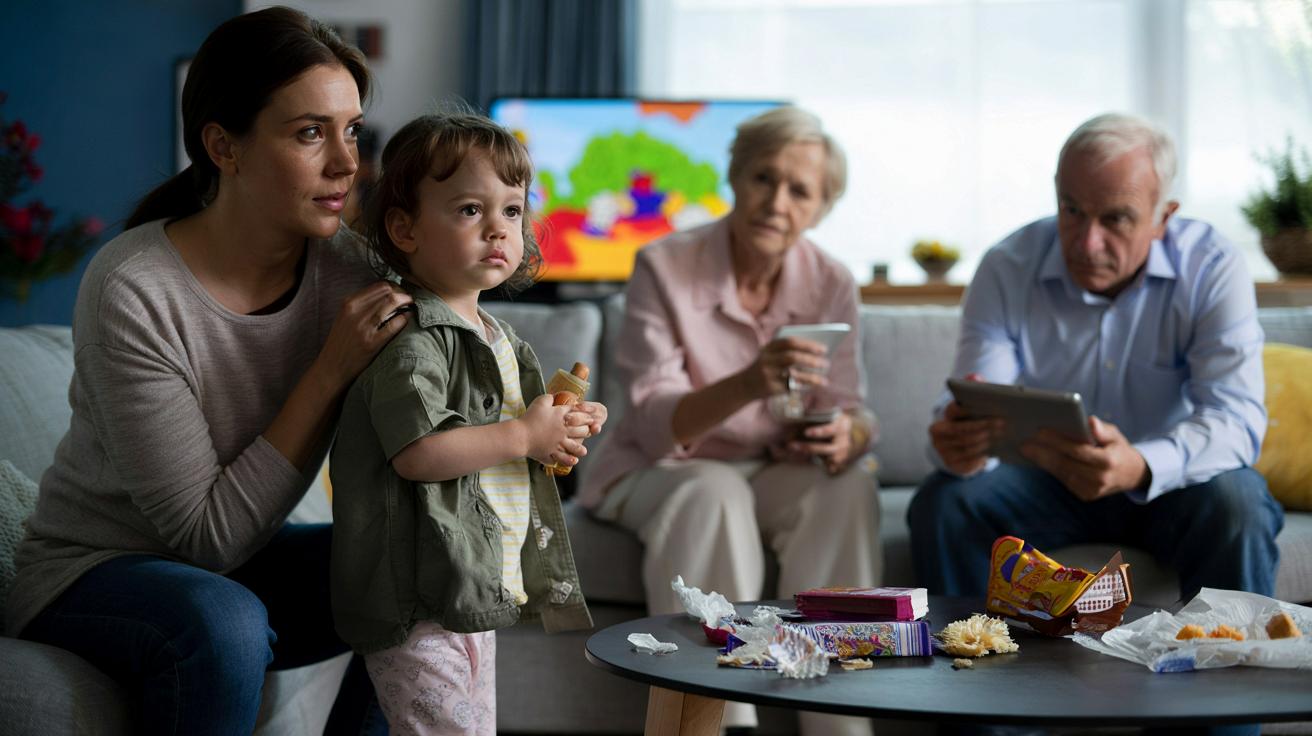
Her son is still awake, eyes glued to a tablet, a half-eaten chocolate bar in his hand. Her father shrugs, slightly guilty: “He didn’t want to sleep, what did you expect me to do?”
On the drive home, her son screams, kicks the seat, refuses to go to bed.
The next morning, he throws a tantrum: “At Grandma’s, I can do what I want.”
➡️ Spraying vinegar on the front door : why people recommend it and what it’s really for
Léa feels betrayed and ungrateful at the same time.
She needs their help. She also feels like she’s losing control of her own parenting.
This isn’t just about sugar and screen time.
It’s about roles.
Your parents were not trained for today’s pace, today’s safety rules, today’s emotional needs. They raised kids in another era, with different norms, different stress, different risks.
When they become regular babysitters, they don’t just fill a gap, they shape your child’s daily routine, habits, and emotional reference points.
That power comes with responsibility they didn’t necessarily sign up for consciously.
And you, torn between gratitude and frustration, stop saying what you really think.
So resentment grows on both sides.
How to hit pause without breaking their hearts
The first step is concrete and unglamorous: change the frequency.
Not the relationship.
Instead of “they can have the kids whenever they want,” move to planned, limited slots.
Once a week after school. One Saturday afternoon a month. A sleepover every two months instead of every weekend.
You’re not banning the grandparents, you’re redefining their role: from substitute parents to special guests.
Grandparents should be the highlight, not the default.
Say it clearly: “We love that you see them. We also need more time to be the main adults in their routine.”
It’s a boundary, not a rejection.
A huge mistake many parents make is waiting until they explode.
They swallow ten small annoyances, then on the eleventh sleepover, they shout: “You never respect our rules!”
Your parents end up hurt and defensive because, from their point of view, they’ve been giving everything.
Often for free. Often while tired. Often while hiding the fact that their backs hurt and they need a nap after two hours of Lego.
Try small, honest conversations instead of accumulated anger.
“I realized that when he comes back from your place, bedtime is really hard. Can we find a middle ground?”
You’re not a bad child for setting limits with your own parents.
You’re a parent protecting your child’s rhythm and your own mental health.
Your parents can be wonderful grandparents without being your primary childcare solution.
- Limit the role
Use grandparents for occasional help, not full-time or default childcare, so they stay in the “special time” zone. - Clarify the rules
Pick 3 non-negotiables (bedtime, screens, food, for example) and communicate them simply, without lecturing. - Talk money honestly
If they’re watching the kids regularly, discuss compensation or support (groceries, paying a cleaner, transport). - Protect their health
Ask directly, “What’s really manageable for you?” and believe them if they say they’re tired. - Keep the emotional link
Offer alternatives: Sunday lunch together, video calls, short visits, playtime at your place instead of long solo babysitting sessions.
Letting your parents be grandparents again, not backup parents
There’s a quiet relief that shows up in families that dare to change this pattern.
The child stops oscillating between two sets of rules every week.
Your parents stop pretending they’re thirty years younger.
They stop carrying toddlers up the stairs with a bad knee and hiding their exhaustion behind jokes.
You reclaim everyday moments with your kids, the difficult ones and the beautiful ones.
Bath time meltdowns, weekday breakfasts, the random questions at 7:43 a.m. about death and dinosaurs.
Those are the moments that build your relationship, not the perfect weekends at Grandma’s with endless gifts and cartoons.
The emotional trap is strong.
Your parents might say, “You’re depriving us of our grandchildren,” when what you’re really doing is refusing to delegate your parenting to them.
Sometimes, their insistence hides other fears: loneliness, aging, the feeling of no longer being useful.
If you only answer with logistics (“I don’t want you to give them sugar”), you miss the deeper layer.
You can acknowledge their fear without giving up your boundaries.
“I get that you’re afraid of seeing them less. I want you in their life for the long run, and that means not exhausting you by putting you in the babysitter role.”
Let’s be honest: nobody really does this every single day.
The plain truth is that not every grandparent is emotionally safe, either.
There are families where “babysitting” also means snide comments, emotional blackmail, or rewriting your parenting in front of your kids.
If your child comes back saying, “Grandpa says you’re too strict,” or “Grandma says you work too much,” that’s not harmless.
That’s confusion.
In those cases, you have even more reason to cut back on solo time and favor shared time where you’re present.
*You’re allowed to protect your child from family patterns you yourself suffered from, even if those patterns wear a sweet-grandparent mask now.*
Taking a step back from grandparent babysitting isn’t ingratitude.
It’s a long-term act of care for everyone involved.
| Key point | Detail | Value for the reader |
|---|---|---|
| Redefine roles | Shift grandparents from “default childcare” to “special time” visitors with limited, planned babysitting | Reduces chaos for kids and tension between generations |
| Communicate boundaries | Choose a few non-negotiable rules and talk about them calmly and early | Protects your parenting choices without dramatic confrontations |
| Protect everyone’s health | Respect grandparents’ physical and emotional limits instead of assuming they can handle everything | Prevents burnout, guilt, and hidden resentment on all sides |
FAQ:
- Question 1How do I tell my parents I don’t want them babysitting so often without hurting them?
Be concrete and caring. Say you want them to enjoy the kids, not feel obligated. Propose precise times that work (for example, “One Wednesday afternoon a month would be perfect”) and emphasize that this change is about balance, not punishment.- Question 2What if my parents ignore my rules when they babysit?
Bring up one example at a time, not a long list. Explain the consequence for your child (“He can’t sleep after screens late”) and calmly link it to future access (“If bedtime is respected, we can keep doing sleepovers, otherwise we’ll switch to afternoons only”).- Question 3My parents say I’m ungrateful. Are they right?
Gratitude doesn’t mean unlimited access or no boundaries. You can be thankful for their love and time while still deciding what’s healthy for your child and your family rhythm. Both can be true at once.- Question 4Is it okay to stop grandparent babysitting completely?
Yes, especially if your child is unsafe emotionally or physically, or if old family wounds are being repeated. You can reduce solo time and focus on shared visits, outings, and shorter, supervised moments together.- Question 5How do I handle guilt when I say no to their babysitting offers?
Notice that guilt and ask what value it’s pointing to: loyalty, respect, love. Then remind yourself that your primary role is to your child’s wellbeing and your own stability. Saying no to one request doesn’t erase everything you share with your parents.